
phone: 817-337-8830

Insight From Our Experts

Bluestone Company Logo

Spotting Fakes:

How to Tell the Difference Between Cubic Zirconia
and Diamonds at the Counter

 Sponsored Content

Every pawnbroker has been there. A customer walks up to the counter with a heavy two-carat solitaire ring, looking for a fast loan. The mounting is stamped 14k gold. The stone is dirty, which makes a quick read tough. Make the wrong call here, and you are out thousands of dollars. 


Cubic zirconia (CZ) has been fooling counters since the 1970s. Because scammers often mount CZs into real gold or platinum settings to pass a surface check, you cannot rely on the metal stamp. You have to know how to read the stone itself. 

Start with Your Loupe 


Before you even reach for an electronic tester, grab your 10x loupe. Clean the stone first. Lotions, soap scum, and skin oils hide obvious tells and can even throw off thermal probes.


Look closely at the facet junctions where the flat surfaces meet:
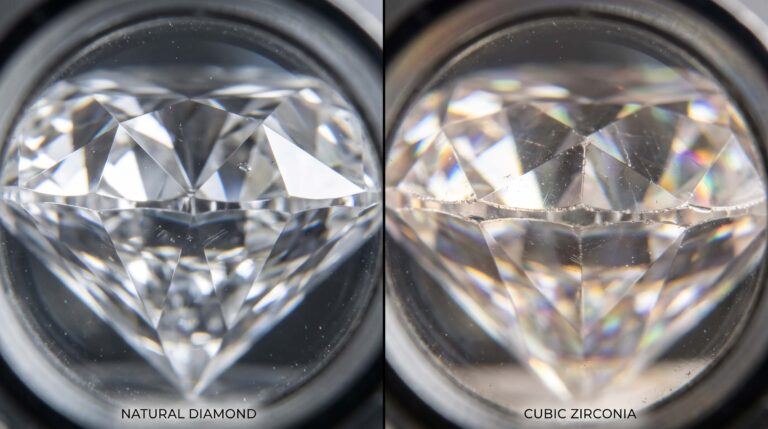
Left: A natural diamond retains razor-sharp facet junctions. Right: Cubic zirconia is softer and shows worn, abraded edges from daily wear. 

  • Facet Edges: Diamond is the hardest natural substance on earth. Its facet junctions are razor-sharp. Cubic zirconia is much softer, rating around 8 to 8.5 on the Mohs scale. Over time, daily wear rounds off the edges of a CZ. Under magnification, those junctions look slightly melted, abraded, or fuzzy.
  • The Girdle: Check the outer edge of the stone. Most natural diamonds have a frosted, bruted, or finely faceted girdle. Older CZs often show a smooth, waxy, or rounded girdle.
  • Flaws and Inclusions: Almost all cubic zirconia is lab-grown to be completely flawless. If you look inside a large stone and see zero inclusions, pinpoints, or feathers, your guard should go up immediately. While Internally Flawless diamonds exist, they are rare at the pawn counter. Occasionally, a cheap CZ will contain tiny, round gas bubbles from the manufacturing process. Natural diamonds never have gas bubbles.

Watch How It Handles Light 

Put the stone under your showcase lights and tilt it slowly. Diamonds and CZs bend light differently. 
Diamonds are famous for crisp, balanced brilliance. They throw off a sharp mix of bright white light (brilliance) and flashes of color (fire). Cubic zirconia has a higher dispersion rate than diamond. In plain terms, a CZ shoots off way too much rainbow fire. Under bright LED showcase lights, a large CZ often looks like a disco ball, flashing heavy orange, blue, and green streaks. 
 

Weight is another dead giveaway 

Cubic zirconia is roughly 55% to 75% heavier than a diamond of the exact same millimeter dimensions. If you have a loose stone that measures 6.5mm across, a round diamond should weigh right around 1.00 carat. A CZ of the same size will tip the scales closer to 1.70 carats. 
 

If the stone is mounted and you cannot weigh it, use the Bluestone Trading Company Diamond Weight Calculator on our website (www.bluestone-trading.com) to estimate what the carat weight should be based on its millimeter measurements. 
 

Quick Counter Tests 

When your eyes tell you something is off, run a few physical checks: 
 
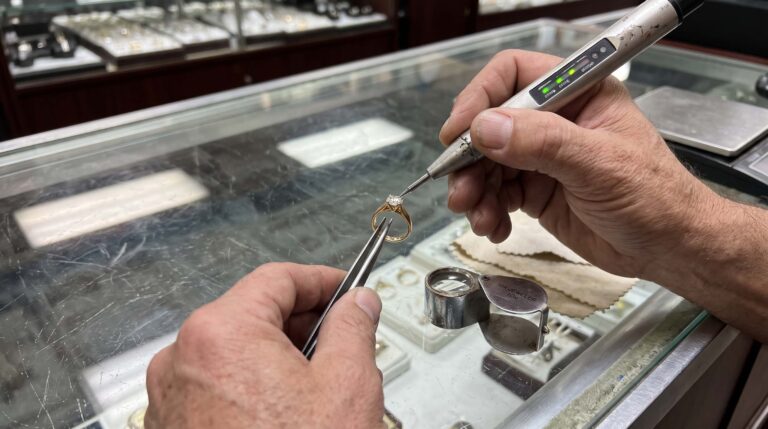
  • The Thermal Tester: Every pawnshop should have a reliable thermal conductivity probe at the buy counter. Diamonds conduct heat rapidly. Cubic zirconia is a thermal insulator. Touch the probe to the center of the table, and a CZ will fail a standard diamond tester every time. Make sure your battery is fresh and let the tip warm up completely between tests. Always pair a 10x loupe inspection with a thermal conductivity test on a clean stone before making an offer at the buy counter.
  • The Read-Through Effect: If the stone is loose or set in an open-back mounting, place it table-down over a piece of paper with small printed text. Because a well-cut diamond bends light so sharply, you will not be able to read the letters through the pavilion. Cubic zirconia has a lower refractive index, meaning light passes straight through more easily. You can usually see distorted black letters or lines right through the stone.
  • The Fog Test: Breathe directly onto the stone like you are fogging up a mirror. A real diamond pulls heat away so fast that the fog clears almost instantly. On a CZ, the moisture sits on the surface for a few seconds before fading. 
 

Take the Guesswork Out of Your Diamond Counter with Bluestone Trading Company   

Protecting your shop starts at the buy counter, and growing your profits comes down to what you do with those stones next. Bluestone Trading Company Inc. is a family-owned business that has been buying and selling diamonds, estate jewelry, and entire store inventories since 1978.

Our online Knowledge Center at www.bluestone-trading.com is built to help your staff buy and sell with confidence. Your team can access free tools right from the counter, including:


  • Virtual Diamond Clarity and Color Grading Charts to see exactly how GIA grades stones. 
  • The Diamond Weight Calculator to estimate carat weights on mounted pieces. 

When your loan drops pull in real diamonds that do not fit your retail cases, our Sell To Us program turns your back-room overstock into immediate cash. We buy directly from pawnshops and jewelry stores, providing free overnight shipping and same-day wire payments. 


If you need clean, accurately graded natural diamonds to stock your cases without the risk of bad buys, our BTC Jewelry Basics collection and Inventory Center have you covered. We supply top-selling diamond studs, tennis bracelets, hoops, and rings that arrive assembled and ready for your showcase. Need a high-ticket piece for a special customer? Ask about our no-cost memo services on loose diamonds and estate jewelry. 


Ready to turn your unwanted diamond inventory into same-day cash or stock your cases with guaranteed sellers?

Visit us online at bluestone-trading.com or call/text us at 440-442-7280.
Get In Touch

With honest handshakes, real offers, and fast, free overnight shipping, Bluestone Trading Company is here to back up your counter every day of the week.